Shopping
Why 30% off plus 20% off is not 50% off
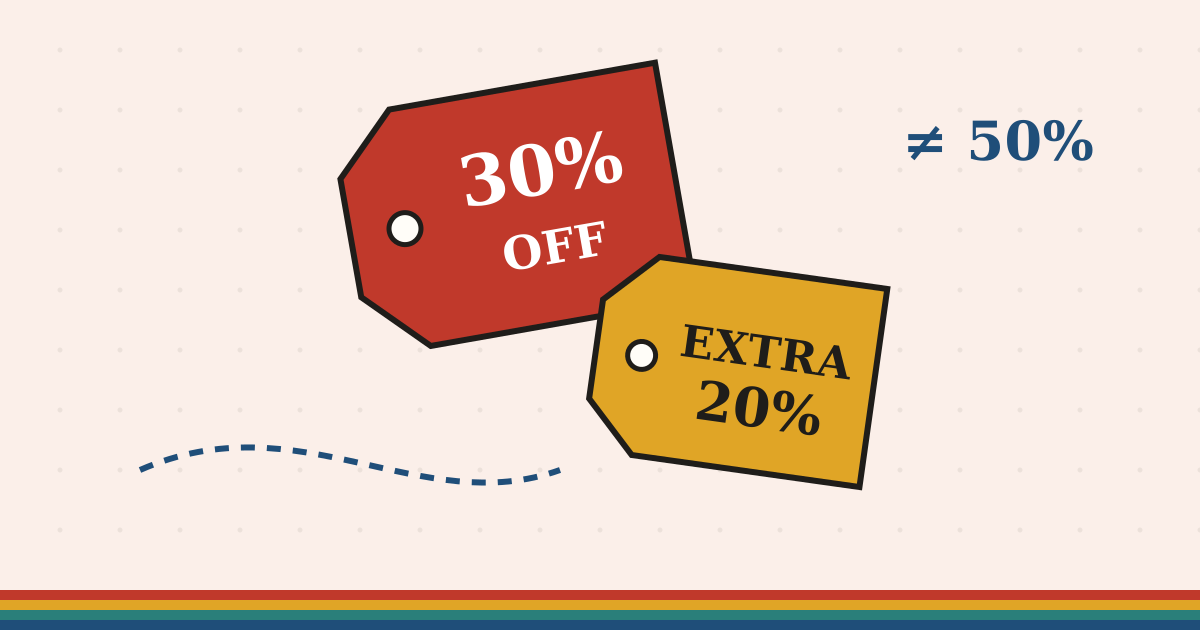
"Take an extra 20% off sale prices!" sounds like a gift. If the item was already 30% off, it is natural to think you are now getting 50% off. You are not, and the reason is worth understanding because it shows up everywhere from shopping to pay rises.
Discounts multiply, they do not add
The second discount is taken off the already reduced price, not the original. So the two percentages work on different numbers. Take a $120 coat:
- 30% off: you pay 70%, so 120 × 0.70 = $84.
- Extra 20% off: you pay 80% of $84, so 84 × 0.80 = $67.20.
You saved $52.80 on a $120 coat, which is 44%, not 50%. The quick way to see it is to multiply what you pay: 0.70 × 0.80 = 0.56. You pay 56%, so the real discount is 44%.
| First discount | Extra discount | Sounds like | Really is |
|---|---|---|---|
| 20% | 10% | 30% | 28% |
| 30% | 20% | 50% | 44% |
| 40% | 25% | 65% | 55% |
| 50% | 50% | 100% | 75% |
Does the order matter?
No. 0.70 × 0.80 is the same as 0.80 × 0.70. Whether the shop applies the coupon first or the sale first, you pay the same.
Percent off or dollars off?
A $20 coupon and a 15% coupon are worth the same on a $133.33 purchase. Below that, the $20 is better; above it, the 15% wins. To find the break-even point, divide the dollar amount by the percentage as a decimal: 20 ÷ 0.15 = 133.33.
Finding the original price
If a tag says $45 after 25% off, the original was not $45 plus 25%. You paid 75% of the original, so divide: 45 ÷ 0.75 = $60. Adding 25% to $45 would give $56.25, which is wrong for the same reason stacked discounts do not add up.
Do not forget the tax
In most US states, sales tax is charged on what you actually pay after discounts. So the $67.20 coat at 8.25% tax costs $72.74 at the till. The sales tax calculator does that step.