Money
Hourly wage to salary, and what to do with it
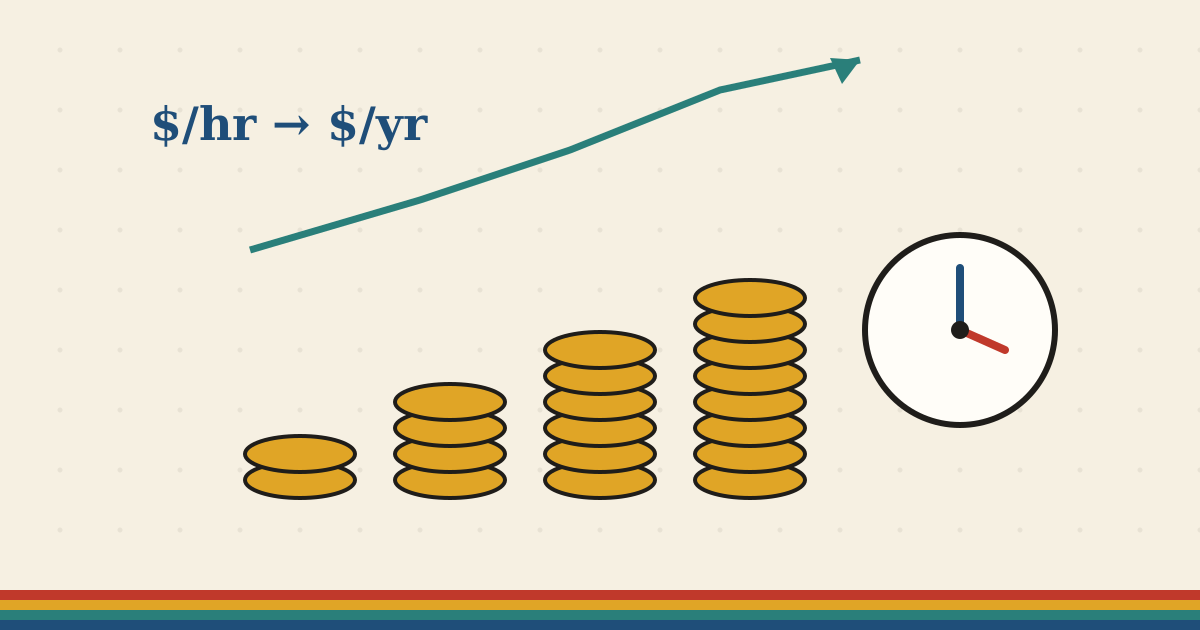
Job adverts mix hourly rates and salaries, and it is surprisingly hard to compare "$22 an hour" with "$46,000 a year" in your head. The conversion is simple once you know how many hours are in a working year.
The 2,080 hour rule
A standard full-time year in the US is 40 hours a week for 52 weeks, which is 2,080 hours. So:
- Hourly to yearly: multiply by 2,080. $22 an hour is $45,760 a year.
- Yearly to hourly: divide by 2,080. $52,000 a year is $25 an hour.
The quick mental version is "double it and add three zeros": $22 becomes about $44,000. It undercounts a little, because it assumes 2,000 hours, but it is fine for a first look.
| Hourly | Weekly (40 h) | Monthly | Yearly |
|---|---|---|---|
| $15 | $600 | $2,600 | $31,200 |
| $20 | $800 | $3,466.67 | $41,600 |
| $22 | $880 | $3,813.33 | $45,760 |
| $25 | $1,000 | $4,333.33 | $52,000 |
| $30 | $1,200 | $5,200 | $62,400 |
When the standard year does not fit
Part-time hours, unpaid holidays and seasonal work all change the sum. Someone on $22 an hour for 30 hours a week and 48 paid weeks works 1,440 hours, which is $31,680 a year, about a third less than the full-time figure. Always use your own hours and paid weeks.
Why a month is not four weeks
A year has 52 weeks, and 52 ÷ 12 = 4.33. Monthly pay is worked out as yearly pay divided by 12, which is why it is a little more than four weekly paychecks.
Gross is not take-home
All of these figures are before tax. Federal and state income tax, Social Security, Medicare, health insurance and retirement contributions come off. For many people, take-home pay is 20 to 30% less than gross.
Turning pay into a savings plan
Once you know your monthly pay, a goal becomes a monthly figure. To save $3,000 in a year with $400 already put aside, you need $2,600 more, which is $216.67 a month. In an account paying 4% a year, interest helps a little and $211.39 a month does it. A common habit is to set that amount to move automatically on payday, so it is gone before you can spend it.