Numbers
How to work out percentages without a headache
Percentages scare more people than they should. There are really only three questions, and each one has a single method. Learn those three and you can deal with discounts, pay rises, tax, tips, test scores and the news.
First, what a percentage actually is
Per cent means "for each hundred". 25% is 25 out of every 100, which is the fraction 25/100, which is the decimal 0.25. Moving between the percentage and the decimal is the one skill everything else rests on: divide by 100 to go from percent to decimal, multiply by 100 to go back.
| Percent | Decimal | Fraction |
|---|---|---|
| 50% | 0.5 | 1/2 |
| 25% | 0.25 | 1/4 |
| 20% | 0.2 | 1/5 |
| 10% | 0.1 | 1/10 |
| 5% | 0.05 | 1/20 |
| 1% | 0.01 | 1/100 |
Question 1: what is X% of Y?
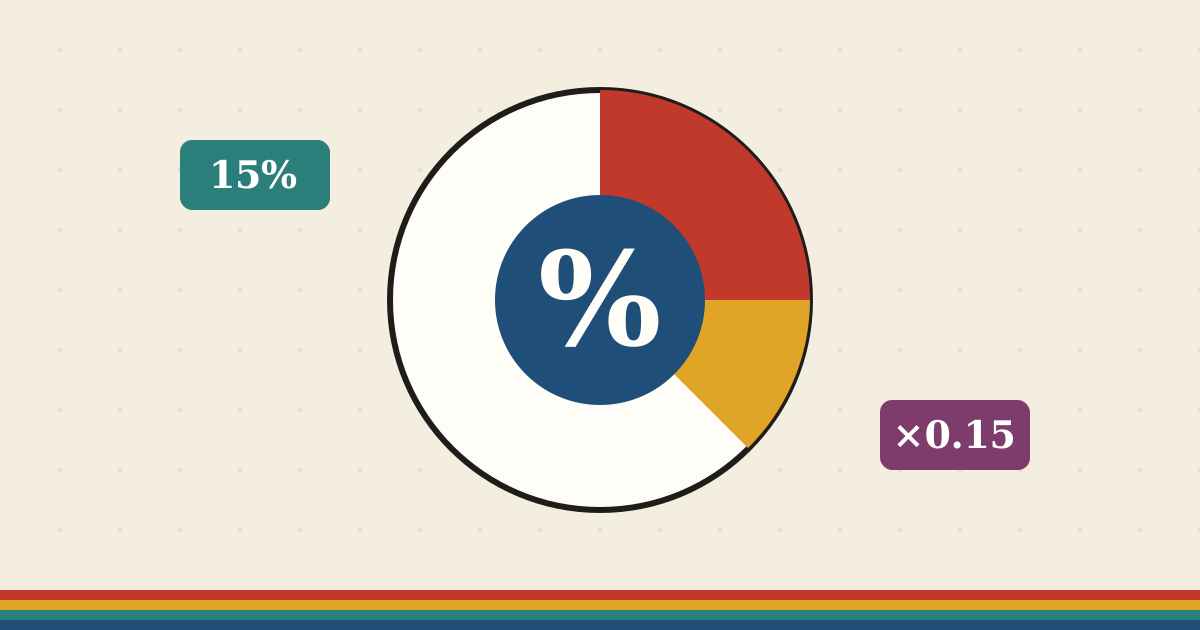
Turn the percentage into a decimal and multiply. 15% of 80 is 0.15 × 80 = 12. On the main calculator you can type it exactly as you say it: 80 × 15 % gives 12.
Question 2: X is what percent of Y?
Divide the part by the whole, then multiply by 100. If you scored 42 out of 48 on a test, 42 ÷ 48 = 0.875, so you got 87.5%. The thing after "of" always goes underneath.
Question 3: what is the percentage change?
Find the difference, divide by the number you started with, multiply by 100. A bill that goes from $64 to $80 has risen by 16, and 16 ÷ 64 × 100 = 25%. People often divide by the new number by mistake and get 20%. The rule to remember: a change is measured from where you started.
Going backwards: the reverse percentage
If a price already has a percentage added or taken off, you cannot undo it by applying the same percentage the other way. A $54.11 total that includes 8.25% tax was not $54.11 minus 8.25%. The tax was added to a smaller number, so you divide instead: 54.11 ÷ 1.0825 = $49.99. The same goes for sale prices: a $68 item after 15% off was 68 ÷ 0.85 = $80 before.
Why up 50% and down 50% does not cancel out
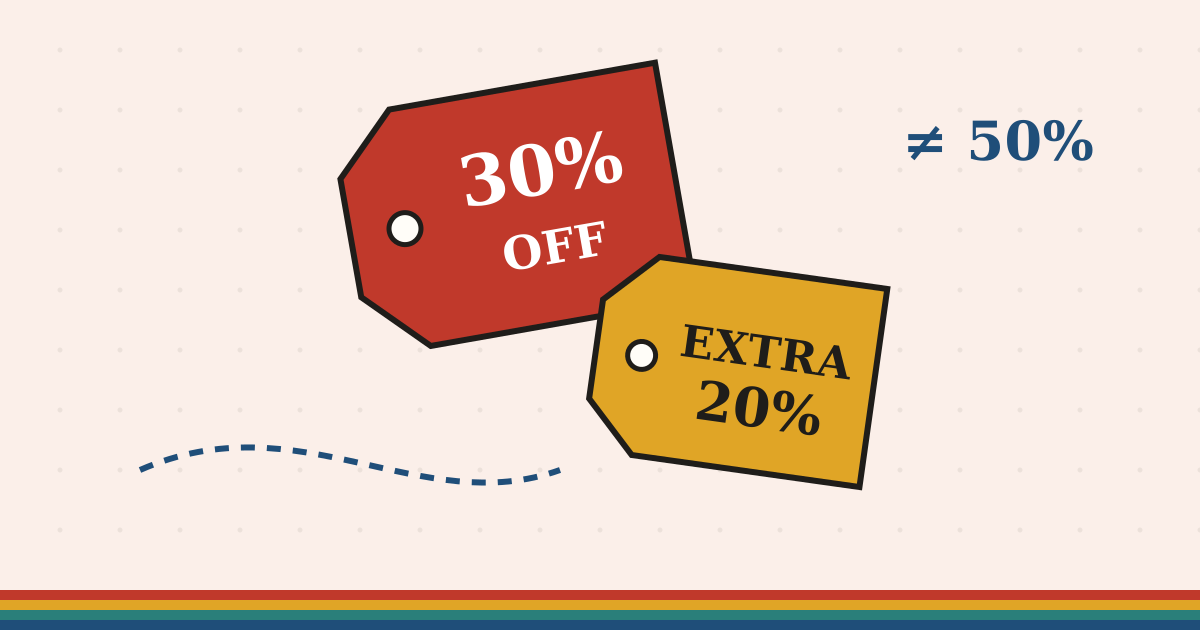
Start with $100. Up 50% is $150. Down 50% from $150 is $75. Each percentage is a share of whatever you have at that moment, so the base keeps moving. This is the same reason two stacked discounts are worth less than they sound, which the discounts guide explains.
Four mental tricks worth knowing
- 10% is a decimal-point shift. 10% of 86.40 is 8.64. Halve it for 5%, double it for 20%.
- Percentages can swap. 8% of 25 is the same as 25% of 8, which is 2. Pick the easier way round.
- 1% is a two-place shift. 1% of 3,250 is 32.50, so 3% is 97.50.
- 15% is 10% plus half of it. On a $60 bill, 10% is 6, half of that is 3, so 15% is 9.
Percentage points are not percentages
If a savings rate moves from 4% to 5%, it went up by one percentage point. In relative terms it went up by 25%, because 1 is a quarter of 4. Both statements are true, and adverts and headlines tend to pick whichever sounds bigger.